DHT Blockers vs Minoxidil: Different Mechanisms, Different Results
DHT blockers and minoxidil are not competing products. They are fundamentally different tools that address hair loss through entirely different biological mechanisms. Understanding this distinction is the key to using them effectively, whether alone or in combination.
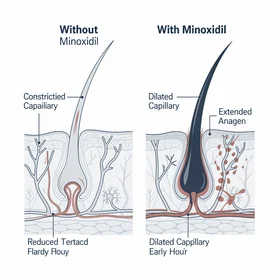
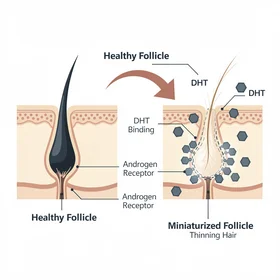
DHT blockers target the cause: reducing the hormone that drives follicle miniaturization. Minoxidil targets the symptom: stimulating blood flow and extending the growth phase independent of DHT. Neither is universally "better." Each works best in specific scenarios, and combining them produces the highest success rates in published research. For a deep dive into exactly how DHT drives follicle miniaturization at the molecular level, the DHT mechanism explained covers the full biological pathway.
Mechanism-Level Comparison
| Factor | DHT Blockers (Natural) | DHT Blockers (Rx) | Minoxidil | Combination |
|---|---|---|---|---|
| Mechanism | 5-AR inhibition + receptor competition (saw palmetto, beta-sitosterol) | Potent 5-AR inhibition (finasteride targets Type 2) | Vasodilation + anagen phase extension (potassium channel opener) | DHT reduction + growth stimulation simultaneously |
| Target Area | Systemic DHT reduction, affects all follicles | Systemic (oral) or scalp-targeted (topical) | Topical only, best at crown/vertex | All areas, multiple pathways |
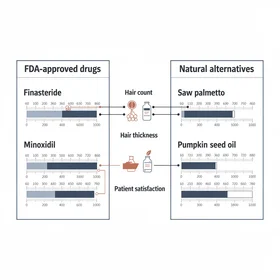
| Efficacy | ~38% improvement (saw palmetto studies) | 83% maintained/improved (finasteride Phase III) | ~60% improvement (topical 5%) | ~94% improvement (published combination data) |
| Side Effects | None reported (sexual), mild GI possible | 1-2% sexual dysfunction risk | Scalp irritation, initial shedding, unwanted facial hair | Depends on Rx component chosen |
| Requires Rx | No | Yes | No (topical OTC) | Partially (if Rx DHT blocker used) |
| Best For | Early stage, prevention, side-effect-averse | Moderate-advanced loss, maximum efficacy | Crown thinning, non-hormonal preference | Best overall results, any stage |
| Works Alone? | Yes, for early stage | Yes, strong standalone evidence | Yes, but does not address cause | N/A (by definition combined) |
The 94% combination figure comes from Hu et al. (2015) studying finasteride + minoxidil. Natural DHT blocker + minoxidil combination data is more limited but the complementary mechanism logic is identical. Efficacy rates come from different study populations and designs. Direct comparison has inherent limitations.
Our Honest Assessment
Why They Work Better Together
DHT blockers and minoxidil address two entirely independent pathways. Using both simultaneously means:
- DHT blockers slow or halt follicle miniaturization (the underlying disease process)
- Minoxidil stimulates follicle activity and extends the growth phase (independent growth signal)
- Follicles get relief from DHT damage AND a direct growth stimulus at the same time
This is why combination therapy consistently produces the highest improvement rates in published research. You are not just adding two modest effects together. You are removing the brake (DHT) while simultaneously pressing the accelerator (growth stimulation). The 94% improvement rate for combination therapy dramatically outperforms either approach alone.
When to Use Each Alone
DHT Blockers Alone
Makes sense for men in early stages (Norwood I-III) who want to address the root cause proactively. If your goal is prevention and maintenance rather than regrowth, a DHT blocker alone may be sufficient. Natural options like Procerin are a rational starting point here: address the mechanism, no prescription needed, evaluate at 6 months.
Minoxidil Alone
Makes sense for men with crown/vertex thinning who want to avoid any hormonal intervention entirely. Also works for men who cannot tolerate DHT blockers for medical reasons. The limitation: minoxidil does not address the underlying DHT-driven process. You are stimulating growth in follicles that are still being miniaturized. Results may plateau or reverse over time as the underlying condition progresses.
The Recommended Approach by Stage
- Norwood I-II (early): Start with a natural DHT blocker alone. Monitor for 6 months. Add minoxidil only if progression continues despite DHT management.
- Norwood II-III (moderate early): DHT blocker + minoxidil from the start. The combination gives you the best probability of maintaining and improving what you have.
- Norwood III-IV (moderate): Consider prescription DHT blocker (finasteride) + minoxidil for maximum medical therapy. Natural options may not be potent enough at this stage.
- Norwood V+ (advanced): Maximum medical therapy to preserve remaining hair. Transplant consultation for restoration. DHT blocker is essential post-transplant to protect native hair.
For a full product-by-product breakdown of what is available in the broader hair loss treatment space, full guide to hair loss products covers every category.
What to Watch Out For
Limitations and Considerations
- DHT blockers (pharmaceutical) carry documented sexual side effects in 1-2% of users. Natural DHT blockers do not have this risk but are less potent.
- Minoxidil requires twice-daily application indefinitely. Inconsistency is the primary reason for disappointing results.
- Initial shedding with minoxidil (weeks 2-6) is common and can be alarming. It typically indicates the treatment is working.
- Combination therapy requires managing two products daily. The time and consistency commitment is real.
- No approach can restore fully dormant follicles. All treatments work best when started early.
- Stopping either treatment means its specific benefit is lost within months. This is a long-term commitment.
Questions About DHT Blockers?

Common questions about DHT, treatment choices, and realistic timelines.
Read the FAQ