
Side effects are the reason most men hesitate before starting a DHT blocker. That hesitation is reasonable. But the conversation around DHT blocker side effects has become distorted by internet forums, where rare adverse events are presented as inevitable outcomes, and by supplement marketing, where side effects are glossed over entirely. Here's what the clinical data actually shows.
Finasteride (Propecia, 1mg oral)
Finasteride is the most prescribed pharmaceutical DHT blocker for hair loss. It inhibits Type 2 5-alpha-reductase, reducing serum DHT by approximately 70%.
What clinical trials report
The pivotal trials (Kaufman et al., Journal of the American Academy of Dermatology, 1998) documented the following adverse events in the finasteride group vs. placebo over 12 months:
Most men who experience these effects see them resolve within weeks of stopping the medication. In the clinical trials, a significant number of side effects also resolved while continuing treatment.
Post-Finasteride Syndrome (PFS)
A subset of men report persistent sexual, neurological, and cognitive symptoms that continue after stopping finasteride. This cluster has been termed Post-Finasteride Syndrome. The FDA added persistent sexual side effects to the drug's label in 2012. PFS remains a contested topic in the medical community. The incidence is difficult to quantify because reporting is largely self-selected, but the condition is real for the men who experience it, and the risk deserves honest acknowledgment.
Men considering finasteride should discuss PFS with their physician and weigh the risk against the demonstrated efficacy. For men who want to avoid this risk entirely, natural DHT blockers offer a lower-potency but dramatically lower-risk alternative.
Dutasteride (Avodart, 0.5mg oral)
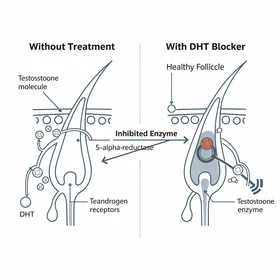
Dutasteride inhibits both Type 1 and Type 2 5-alpha-reductase, suppressing serum DHT by approximately 90%. It is not FDA-approved for hair loss (approved for benign prostatic hyperplasia) and is used off-label.
The side effect profile is similar to finasteride but with two important differences:
- Longer half-life (5 weeks vs. 6 to 8 hours): If side effects occur, they take significantly longer to resolve after stopping.
- Greater DHT suppression: The more aggressive hormonal impact may produce slightly higher rates of sexual side effects, though head-to-head comparison data is limited for the hair loss indication.
Dutasteride is generally considered a second-line option for men who don't respond adequately to finasteride or who tolerate it well and want stronger DHT suppression.
Natural DHT Blockers: Saw Palmetto, Beta-Sitosterol, Pumpkin Seed Oil
The side effect profile of natural DHT blockers is where they clearly differentiate from pharmaceuticals.
Saw palmetto
The most commonly reported side effects in clinical trials are mild gastrointestinal symptoms (stomach discomfort, nausea) in a small percentage of users. No sexual side effects have been reported at rates above placebo in any controlled trial. Saw palmetto has been used for decades in Europe for prostate health with an established safety record.
Beta-sitosterol
Generally well-tolerated. Rare reports of gastrointestinal discomfort. No documented sexual side effects or hormonal disruption.
Pumpkin seed oil
The 2014 randomized controlled trial reported no adverse events in the treatment group over 24 weeks. This is consistent with its long history as a dietary supplement.
| Compound | Sexual side effects | GI effects | Persistence risk | DHT suppression |
|---|---|---|---|---|
| Finasteride | 1.3 to 3.8% (above placebo) | Rare | PFS reported | ~70% |
| Dutasteride | Similar or slightly higher | Rare | Longer resolution (5-week half-life) | ~90% |
| Saw palmetto | Not reported above placebo | Mild, uncommon | None reported | Modest |
| Beta-sitosterol | None documented | Rare | None reported | Mild |
| Pumpkin seed oil | None documented | None in RCT | None reported | Mild to moderate |
Topical Finasteride: A Middle Ground?

Topical finasteride (applied directly to the scalp) is emerging as a compromise between efficacy and side effect risk. Early studies show comparable hair count improvement to oral finasteride with significantly lower systemic DHT reduction, which may translate to fewer sexual side effects. This is a space worth watching as more clinical data accumulates.
The Real Decision Framework
The side effect question is really a risk-tolerance question. Here's how to think about it:
- If you want zero sexual side effect risk: Start with natural DHT blockers. Procerin combines saw palmetto and beta-sitosterol in an IRB-studied formulation. Pair with a ketoconazole shampoo for topical support.
- If natural options prove insufficient after 6 to 12 months: Discuss finasteride with a physician. Start at the standard 1mg dose and monitor for 3 months.
- If finasteride isn't enough: Dutasteride is a more aggressive option, but the longer half-life means committing to a longer risk window.
The right approach depends on your stage of loss, your risk tolerance, and how aggressively your hair loss is progressing. For most men in early stages, starting conservatively with natural options and escalating only if needed is the most rational path.